Bandle - Guess the song
- 4.2
- Rating
- 500.00K
- Installs
- Free
- Price
 Analysis by App-foxy
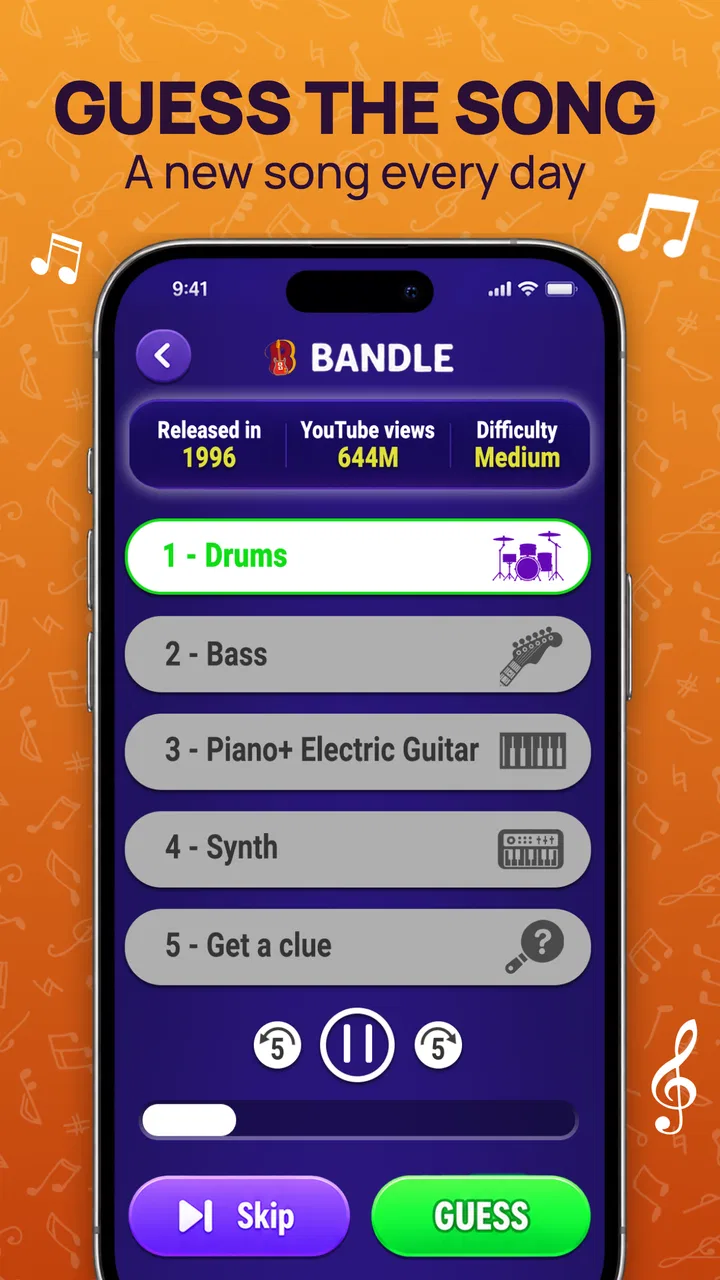
I enjoy music games that test recognition without turning the experience into a serious study session, and Bandle - Guess the song has a clever way of doing that. Instead of playing a familiar track in full and asking me to identify it, the game builds the challenge around a single instrument. That small change makes even well-known songs feel unfamiliar, because I have to listen to arrangement, rhythm, and tone rather than depend on a singer’s voice.
Created by Bandle, this free music game sits in a comfortable space between a daily brain teaser and a casual party activity. It is suitable for Everyone, runs on Android 7.0 or later, and the current version is 7.6.1. The game has reached over 500 thousand installs and holds a 4.0 average from around 2 thousand ratings, which suggests a solid audience without making it feel like an overcrowded social platform.
How the single-instrument idea changes music guessing
The central rule is easy to understand: I hear music built around one instrument and try to name the song. That sounds simple until the familiar vocal melody disappears. A guitar line, piano phrase, drum pattern, or other isolated musical clue can be enough to trigger recognition, but it can also leave me completely unsure when several songs share a similar structure.
You May Also Like

 AccuWeather: Weather Radar
AccuWeather Review: A Quick, Clear Forecast for Everyday Decisions
For everyday plans, the best forecast is the one you can understand quickly. AccuWeather makes rain timing, radar, and local conditions easy to act on, with a few trade-offs.

 Hill Climb Racing
Why Hill Climb Racing Still Turns Crashes Into One More Run
A tiny car, a bumpy hill and one more upgrade: Hill Climb Racing keeps resurfacing because its simple chaos makes every near-miss feel personal.

 AliExpress - Shopping App
AliExpress Makes Global Shopping Feel Personal, but Shoppers Bear the Risk
AliExpress turns a global marketplace into a pocket-sized discovery engine. Its reach is useful, its shopping loop compelling, and its trade-offs easy to miss.

 Lords Mobile: Kingdom Wars
Lords Mobile Is a Kingdom-Building Routine, Not a Quick Match
A case-by-case verdict on the building, battles, device demands, and social commitments that make Lords Mobile rewarding for some players and exhausting for others.

 PDF Scanner app - TapScanner
TapScanner Makes Paperwork Easier to Capture, Check, and Share
TapScanner makes scanning with a phone feel less like a rescue operation and more like a dependable step in getting work done. Its capture tools are useful, though not flawless.

 Block Blast!
 Shows How Much a Puzzle Game Can Leave Out
A quiet grid game shows why puzzle players increasingly value instant clarity, repeatable skill and low-pressure play—and where the genre still needs to catch up.
More From Our News Desk
View All News


That is the game’s strongest idea. Ordinary music quizzes often reward instant recall, especially when they begin with a famous chorus. Here, the opening clue can be much less obvious. I need to think about where I may have heard the melody, whether the rhythm belongs to a particular era, and what kind of song would normally use that instrumental phrase. The result feels closer to solving a small audio puzzle than simply shouting out a title.
I also like that the concept works for different levels of musical knowledge. Someone who listens casually can guess songs through memory and mood, while a more experienced listener may focus on chord movement, tempo, or the character of the instrument. Neither approach guarantees success. A person who knows thousands of songs may still struggle if the chosen part hides the most recognizable feature.
A useful game for short breaks
I would use this game in the same situations where I might open a crossword or a quick word puzzle: while waiting for an appointment, during a short commute, or when I want something interactive without committing to a long session. The basic premise does not require a complicated tutorial, a large time investment, or a long explanation to friends.
It also fits a relaxed group setting. One person can play a round aloud while others suggest answers, turning a solitary guessing challenge into a small music conversation. That works particularly well when people have different listening habits. A song that is obvious to one friend may be completely invisible to another, and those disagreements are part of the entertainment.
There is a practical trade-off, though. The game depends heavily on the player’s familiarity with the songs it chooses. If the selection does not match your tastes or musical background, the challenge may feel arbitrary rather than rewarding. This is not a rhythm game where skill can compensate for unfamiliar material. Recognition remains the main skill, so the experience is naturally stronger for people who enjoy broad music quizzes.
Why the instrument matters more than the title
When I approach a round, I try not to ask only, “What song is this?” I first listen for the role of the instrument. Is it carrying the melody, marking the beat, or supplying a repeated hook? That distinction is useful because a song may be recognizable through its arrangement even when the isolated sound is not immediately familiar.
A good method is to listen once without guessing, then replay the clue while mentally adding possible vocals or other instruments. I find that this prevents a random first impression from sending me toward the wrong genre. It also makes the game more satisfying because I am analyzing the musical structure instead of tapping answers at random.
Another helpful habit is to separate confidence from certainty. I may recognize a melody but not remember the exact title, or know the artist but confuse two songs with similar openings. Treating the first thought as a lead rather than a final answer makes the rounds feel less frustrating. This is especially useful for players who are good at remembering tunes but poor at recalling names.
What the current version means for players
The current release, 7.6.1, gives the game a fairly mature starting point for anyone discovering it now. The title was released on December 13, 2023, so it is not a brand-new experiment. Its continued presence and the number of people who have installed it indicate that the basic format has had time to find an audience.
I would not treat the version number as a promise that every player will have the same experience forever. Music games can change in ways that are easy to miss, such as adjustments to the song pool, answer handling, or the balance between accessible and difficult clues. What matters most in daily use is whether the available rounds continue to feel varied and fair. A clever concept loses its appeal if the same patterns become too predictable.
For an existing player, a newer version is most valuable when it keeps the challenge feeling fresh without changing the central identity of the game. The single-instrument format is already distinctive, so I would rather see careful refinement than unnecessary complexity. If you return after a break, the best test is simple: do the rounds still make you think about songs in a different way, or do they now feel like repeated recognition exercises?
What the game does well for returning users
Its strongest long-term quality is replayable discussion. Even when I miss an answer, I often remember the sound of the clue and think about why it fooled me. That gives the game more staying power than a quiz where the only result is right or wrong. The instrumental focus creates a small learning curve: over time, I become more attentive to parts of songs that I previously ignored.
It can also encourage better listening outside the app. After playing, I notice bass lines, drum patterns, and backing melodies more clearly in ordinary music. That is a subtle benefit, but it is one reason I see this as more than a basic title-recognition test. The game trains attention to arrangement, even if it does not present itself as a formal lesson.
At the same time, returning users should expect the novelty to depend on the material. If I already know a clue instantly, a round may be satisfying but brief. If I do not know the song at all, the challenge may become guesswork. The sweet spot is a melody I recognize only after concentrating, and the quality of the experience depends on how often the game reaches that middle ground.
Free access and the role of purchases
Bandle - Guess the song is free to start, which makes it easy to try without treating the first session as a commitment. There are in-app purchases ranging from $0.99 to $29.99 per item. I would approach those options carefully and decide whether they add meaningful convenience for my own play style rather than buying automatically.
For a casual player, the free experience is the important first test. I would play enough rounds to learn whether the song choices suit me, whether the clues feel fair, and whether I enjoy the instrumental approach when I do not know an answer. If those basics work, an optional purchase may feel reasonable; if they do not, spending more will not solve the underlying mismatch.
This pricing structure also matters for families. Because the age rating is Everyone, the game is broadly approachable, but an adult should still review purchase settings before handing over a device. The rating describes suitability, not whether every optional transaction fits a household’s rules. That is a small but practical step that avoids an unpleasant surprise during an otherwise harmless music game.
Where it fits among music-game alternatives
Compared with a conventional music quiz, this game is less dependent on instantly recognizable vocals and more focused on instrumental detail. That makes it a better choice for someone who wants a listening puzzle rather than a rapid-fire trivia test. A standard quiz may be more satisfying if I care mainly about artist names, release knowledge, or broad music facts.
It is also different from a rhythm game. Rhythm titles usually measure timing, coordination, or reaction speed, while this one measures memory and interpretation. I do not need to perform a song or match notes precisely. If I want energetic interaction and visible skill progression, a rhythm game would probably be a better fit. If I want to sit back and debate what a melody reminds me of, this format has the advantage.
Compared with streaming music discovery, the purpose is reversed. A streaming service helps me find something new to listen to; this game asks me to retrieve something already stored in my memory. It is therefore not a replacement for a music library or recommendation app. I see it as a companion activity for people who already enjoy songs and want to test how well they notice the details inside them.
Small strategies that make difficult rounds fairer
My first recommendation is to listen for repetition. A short instrumental clue may seem vague at the beginning, but repeated notes often reveal the hook. Instead of trying to identify the entire song at once, I focus on the smallest phrase that returns. That phrase is usually more useful than the overall mood, which can be shared by hundreds of tracks.
Second, I mentally remove the instrument from the clue and imagine the original arrangement. If the sound is a piano phrase, I picture where a vocal would enter. If it is a rhythmic part, I consider whether it would normally sit beneath a chorus or a verse. This imagined reconstruction is more reliable than searching memory by genre alone.
Third, I use wrong answers as information. A failed guess can reveal whether I am confusing tempo, melody, or instrumentation. For example, if I repeatedly mistake songs with similar rhythms, I know I should listen to the note sequence rather than the beat. That turns mistakes into a personal listening exercise instead of a reason to quit.
For group play, I would have everyone state a clue before offering a title: “the rhythm sounds like a chorus,” “the melody feels familiar from radio,” or “the instrument is carrying the main hook.” This keeps one confident player from dominating immediately and makes the conversation more interesting. It also shows why a guess seems plausible, which is where much of the social fun comes from.
Who will enjoy it most
I recommend it to people who like music trivia but want a twist that makes easy songs less obvious. It is especially suitable for listeners who enjoy comparing memories, identifying melodies, and noticing production details. It can also work for families or friends looking for a low-pressure activity that does not require everyone to be equally competitive.
It is less suitable for someone who wants a large amount of control over what plays. If I want to select my own artists, genres, or playlists, a music service or a more customizable quiz may serve me better. I would also skip it if I dislike guessing games where an unfamiliar song can leave me with very little to work from. The challenge is intentional, but not every player will find that uncertainty enjoyable.
Players who expect a traditional game progression should set their expectations accordingly. The appeal here comes from the act of recognizing and discussing songs, not from complex character systems, elaborate worlds, or performance mechanics. That focused design is a strength for quick sessions, but it may feel limited to anyone seeking a deeper game structure.
Questions I would ask before installing
Does it require advanced musical knowledge? In my experience, no. Musical vocabulary can help, but ordinary listening memory is more important. I can solve a clue because I remember a melody, not because I know the technical name of the instrument or the theory behind the arrangement.
Is it appropriate for younger players? The Everyone rating makes it broadly accessible, and the concept itself is clean and easy to explain. Still, younger players may find some songs harder simply because they have had less time to build a library of musical memories. Playing together with an older family member can make the experience more welcoming.
Can it replace a music-learning app? I would not use it that way. It encourages attentive listening and may sharpen awareness of instrumental parts, but its goal is guessing songs, not teaching notation, technique, composition, or structured theory. For lessons, practice, or formal musical development, a dedicated education app is the better choice.
Is it worth paying for optional items? That depends on how often I play and how well the available challenges match my taste. I would first establish that I enjoy the free experience. Since individual purchases can range from $0.99 to $29.99, I would check the exact item and use device purchase controls, particularly on a shared phone or tablet.
My view after weighing the strengths and gaps
The best thing about Bandle - Guess the song is that it finds difficulty in a simple place. Removing the full arrangement makes familiar music feel newly puzzling, and it rewards the kind of listening I usually do not practice deliberately. I like that a round can be quick while still giving me something to think about afterward.
The main limitation is equally clear: the game cannot guarantee that every clue will connect with every player. Song familiarity, personal taste, and memory all shape the result. Some rounds will produce an exciting moment of recognition, while others may feel like an answer I could never reasonably have reached. That unevenness is normal for this format, but it is important to understand before expecting a consistently satisfying score.
For me, the game is strongest as a small daily habit or a shared challenge, not as an all-day replacement for other music entertainment. I would open it when I want to test my memory, challenge a friend, or listen more closely to how songs are built. I would choose a rhythm game for active play, a standard trivia game for factual questions, and a streaming app for discovery.
What I would watch over time is the freshness and fairness of the song experience. A healthy direction would keep the central instrument-based identity while making sure returning players still encounter clues that are varied, recognizable in hindsight, and not dependent on one narrow musical background. If that balance holds, the current version has a strong reason to remain installed.
My final recommendation is straightforward: try it if you enjoy identifying songs and do not mind being challenged by music you thought you knew. The real appeal is not simply naming a track; it is learning to hear the hidden part that makes the track memorable. It is free to begin, broadly accessible, and distinctive enough to stand apart from ordinary music quizzes. Just keep expectations realistic, treat purchases as optional decisions, and remember that the game is at its best when the wrong answer makes you listen again.
FAQs for Bandle - Guess the song
01What is Bandle - Guess the Song about?
Bandle - Guess the Song is a fun and interactive music trivia app where users can test their knowledge of songs across various genres and decades. Players listen to short clips from songs and try to guess the title or artist as quickly as possible. It’s perfect for music lovers who enjoy a challenge.
02How do the game mechanics work in Bandle?
In Bandle, users are presented with a short audio snippet from a song and must guess the correct title or artist from multiple-choice options. The faster you answer, the more points you score. The game features various levels and challenges to keep users engaged and motivated to improve their music knowledge.
03Is Bandle suitable for all ages?
Yes, Bandle is designed to be family-friendly and suitable for users of all ages. The app features a wide range of music genres, from classic hits to the latest chart-toppers, making it accessible and enjoyable for everyone, whether you're a seasoned music aficionado or a casual listener.
04Does Bandle require an internet connection to play?
Bandle requires an internet connection to stream the song clips and access the latest updates and features. This ensures that users have access to a diverse and up-to-date library of songs. However, some features like previously completed challenges may be available offline.
05Are there any in-app purchases in Bandle?
Yes, Bandle offers in-app purchases that allow users to enhance their gaming experience. These may include additional song packs, hints for difficult questions, or ad-free gameplay. While the basic version of the game is free, these optional purchases offer added convenience and fun for dedicated players.
Pros
- Engaging music trivia gameplay
- Wide variety of music genres
- Regularly updated song library
- User-friendly interface
- Multiplayer mode for added fun
Cons
- Limited offline functionality
- Occasional ad interruptions
- Some songs repeat frequently
- Requires internet for updates
- In-app purchases can add up

Bandle - Guess the song
Gallery